
Aamir Khan at the BFI: The Courage, Curiosity and Charisma of a True Cinema Icon
At a special London Indian Film Festival event at BFI Southbank, Aamir Khan looked back on four decades of Indian cinema, sharing stories of failure, courage, creative conviction and the childhood influences that shaped him. We left not simply impressed by the star, but deeply inspired by the thoughtful, funny and disarmingly humble man behind some of Indian cinema’s most important films.
It was one of those glorious London summer days when the Southbank seemed to shimmer with possibility. Inside the BFI, however, the real excitement centred around a man whose work has shaped generations, crossed borders and repeatedly challenged our understanding of what mainstream Indian cinema can be. Organised by the London Indian Film Festival, the on-stage conversation with Aamir Khan drew admirers, film professionals, media and lifelong fans, all eager to hear from an actor, producer and director whose career has never followed the safest or most predictable route. There was affection in the room before he had even spoken, but what unfolded over the evening was far more revealing than a conventional retrospective. Khan was witty, candid and wonderfully self-aware, moving effortlessly between stories of childhood ambition, career-defining failure, personal heartbreak and the creative principles that have sustained him for more than four decades.

For someone who has played sportsmen, revolutionaries, romantic heroes, teachers, fathers and unforgettable outsiders, Khan admitted that he had very little idea what he wanted to become as a child. Tennis, rather than acting, initially occupied his imagination, and he was good enough to compete at state level. His later appearance in an exhibition match involving Roger Federer and Novak Djokovic was remembered with the kind of self-deprecating humour that would recur throughout the evening. Having not played properly for years, he found himself struggling so badly with his serve that Federer and Djokovic attempted to lower the net for him. “I have the distinction of having Federer and Djokovic sitting on either side of the net, trying to lower it so my serve would go over,” he laughed. “I’m the only person who has had that privilege.” It was a wonderfully human opening, instantly dismantling the distance between global star and audience.
Cinema, however, had always been around him. His father and uncle were filmmakers, and Khan grew up listening to writers and directors pitch stories at the family home. He remembered sitting quietly in a corner, absorbing the narratives and the conversations that followed. Yet despite this upbringing, his parents actively discouraged him from entering the industry. They understood its volatility too well, knowing that someone could be celebrated one day and forgotten the next. Khan, thankfully for cinema, did not listen. His earliest experiences on set were not especially glamorous. At three or four years old, he was reportedly cast as Shashi Kapoor’s son in Pyar Ka Mausam, only to be removed from the film after crying and failing to complete the shot. His younger brother was promptly drafted in as a replacement. Years later, while working on Yaadon Ki Baaraat, his strongest memories were of the unpleasant smell of pancake makeup, the darkness and noise of the studio, and playing cricket between takes. Even in these stories, there was no attempt to mythologise his beginnings. He spoke about them with affection, but also with refreshing honesty.
The real turning point came when he was around 15 and helped his school friend Aditya Bhattacharya make a short film called Paranoia. “That one month of trying to grapple with telling a story is what really got me interested in films,” he explained. “That’s when I knew that this is the world I want to live in.” He went on to work backstage in Gujarati theatre, ironing clothes, serving tea and learning from the wings before unexpectedly being asked to step into a role. It was a reminder that one of Indian cinema’s most revered performers began not with entitlement or instant stardom, but through observation, assistance and a willingness to do the unglamorous work.
Much of the evening focused on the choices that distinguished Khan from his contemporaries. He spoke frankly about entering an industry where leading actors might be committed to 30, 40 or even 70 films at once. After the enormous success of Qayamat Se Qayamat Tak, he signed eight to ten projects, believing this was relatively restrained. It quickly became overwhelming. He found himself working three shifts a day, moving between three separate films and three completely different characters. More painfully, he realised that the films being made did not resemble the films he had imagined when reading their scripts. “I used to come back from work and cry,” he admitted. “I was really unhappy with the work I was doing.”
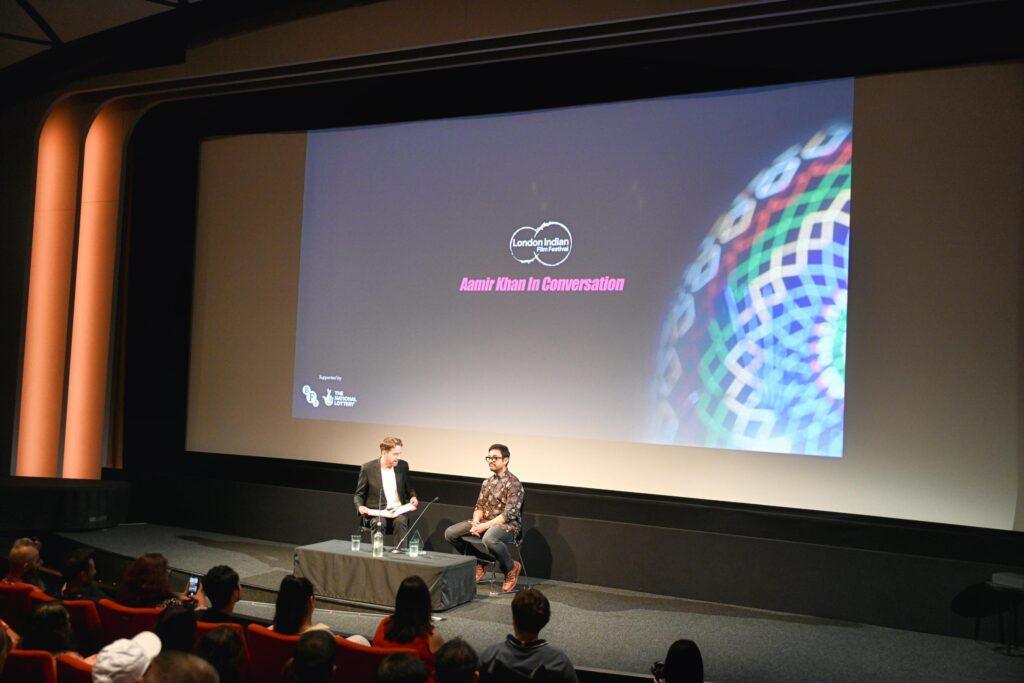
From that experience came the three pillars that would guide his career: a strong script, a director whose vision and sensibility he trusted, and a producer prepared to give the creative team the resources and support necessary to realise that vision. The most inspiring story of the evening concerned his decision to turn down a film offered by Mahesh Bhatt at a time when Khan’s career was in serious difficulty. Several of his films had failed, others were waiting to be released, and the media had begun describing him as a one-film wonder. A project with one of the country’s most successful directors could have restored his credibility overnight. There was only one problem. He did not believe in the script.
“I knew my good sense was telling me, ‘Just say yes. You need this film,’” he recalled. “And my other side was telling me, ‘You’ve promised yourself you won’t make this mistake again.’” He barely slept before returning the following day to decline the opportunity. “Had I compromised that day, I think my entire career would have been a series of compromises,” he reflected. “But when I could stick to what I believed in at my worst, it gave me a lot of strength.” It was perhaps the most powerful moment of the evening. Success often makes conviction look easy, but Khan’s principles were formed when his back was against the wall, when saying no carried a genuine cost. His career became not simply a story of talent, but of boundaries, courage and trusting one’s own instincts when external validation disappears.
That same instinct eventually led to Lagaan, a film he loved so much that he became a producer despite having no previous desire to do so. The production was difficult, uncertain and filled with daily crises. Khan and director Ashutosh Gowariker frequently echoed a line from a deleted scene in which Bhuvan wonders whether he has made a terrible mistake by accepting the challenge. Yet what drew Khan to the film was not simply cricket or colonial history, but “the triumph of the human spirit”. The extraordinary success of Lagaan, both in India and internationally, widened the possibilities of mainstream Indian cinema. It showed filmmakers and audiences that ambitious, unconventional stories could also become major commercial and cultural events.
Khan’s creative philosophy remains deceptively simple. He does not try to predict what audiences want. “I like to go with what excites me,” he said. “And I’m hoping that if we do a good job, then it will also excite an audience.” It is an approach that explains a filmography containing everything from Taare Zameen Par and 3 Idiots to PK, Dangal, Delhi Belly and Peepli Live. He likes challenge, transformation and uncertainty. When asked whether he might enjoy being a character actor who appears for a few days without carrying the weight of an entire production, his reply was instantaneous: “Not at all.” After a pause, he added with a grin, “I still want to be the lead. Let’s be honest.” The room erupted. It was vintage Aamir Khan, serious about the craft but never too serious about himself.
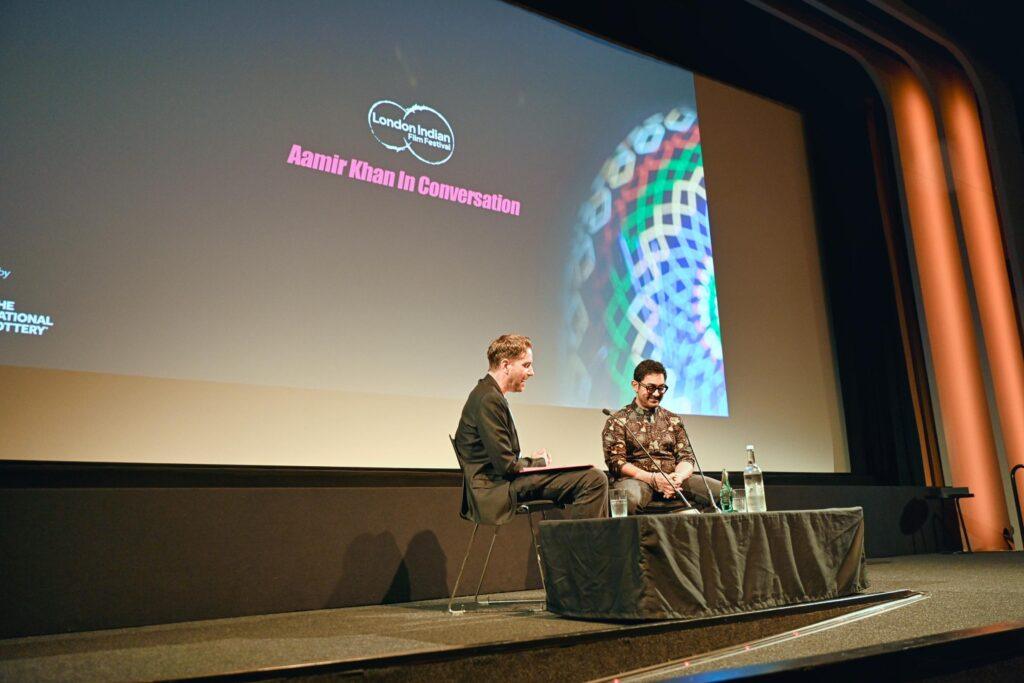
His thoughts on contemporary audiences were equally perceptive. Smartphones, social media, streaming platforms and constant notifications have changed not only viewing habits, but human attention itself. Filmmakers, he observed, once told stories to captive cinema audiences. Today they are speaking to distracted people with the entire world in the palms of their hands. “Now I have to tell a story to a distracted audience,” he said. Yet despite shifting technologies and consumption habits, he remains convinced that story is still paramount. Spectacle may attract attention, but without emotional connection, it cannot endure.
Perhaps the most moving insight came when Khan was asked where his social conscience originated. He credited his mother, recalling how she would ask whether he had won his tennis matches. On one occasion, after celebrating his victory, she suddenly became thoughtful. The boy who had lost, she explained, would also be arriving home, where his own mother would hear that he had been defeated. She was thinking not only of her son’s happiness, but of another mother’s disappointment. “Her ability and her quality of thinking of the other,” Khan said, “is something that seeped into me.” It was easy to see the connection between that childhood lesson and a body of work that has repeatedly invited audiences to look beyond themselves, towards children who learn differently, families under pressure, communities divided by prejudice and individuals fighting systems larger than themselves.
By the end of the evening, what remained was not simply the scale of Aamir Khan’s success, but the values beneath it. He is exacting without appearing arrogant, philosophical without becoming distant, and serious about cinema while still capable of laughing at his hairstyles, his failed tennis serves and his inability to resist a game of Settlers of Catan. He spoke openly about divorce, professional failure and emotional exhaustion, but without self-pity. He talked about preparation, repeating lines thousands of times until they became instinctive, yet made his achievements sound like the result of curiosity rather than genius.
Aamir Khan has often been called a perfectionist. After hearing him speak, that description feels incomplete. He is, above all, a man committed to intention. He chooses carefully, questions deeply and believes that the work must mean something before it can succeed. On a beautiful summer’s day in London, surrounded by people who had grown up with his films, he reminded us that the most inspiring careers are not created through constant triumph. They are created in the moments when compromise would be easier, fear would be understandable and saying no might cost everything. His films have entertained millions, but it is perhaps that quiet courage, delivered with warmth, wit and unmistakable charisma, that makes Aamir Khan truly legendary.