“I know. I’m old.”
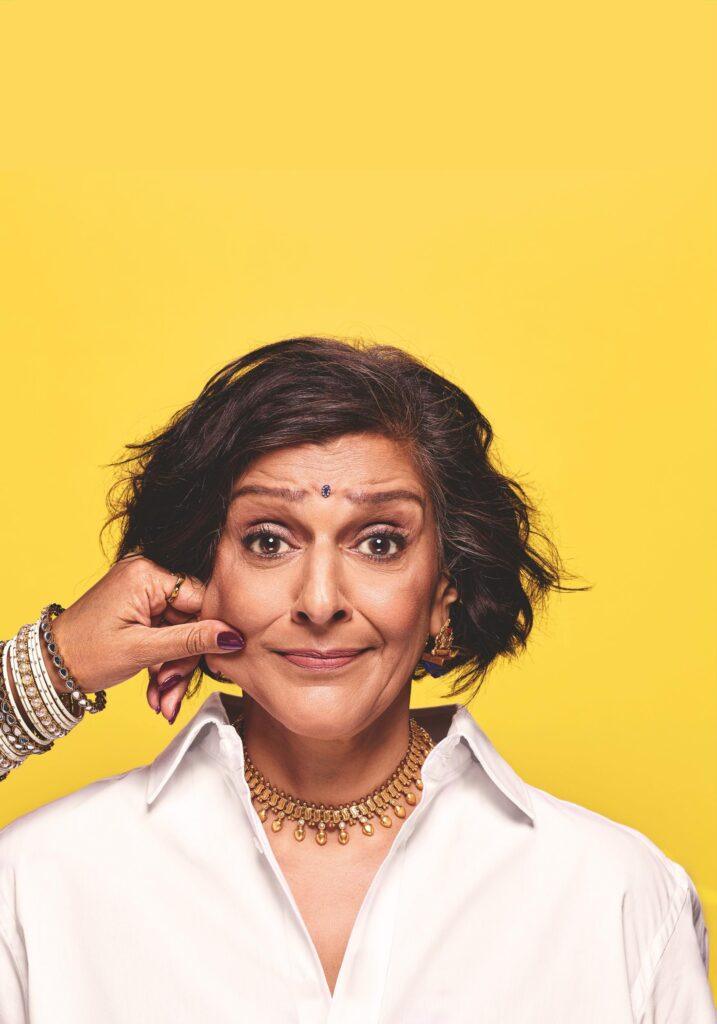
That was Dame Meera Syal’s reply when I told her, slightly breathlessly, that she’d been part of our lives for decades. I’d already warned her I might have a Victoria Wood moment. I was nervous, and I think it showed.
You can’t really blame me. For most of us, Meera is Smita Smitten, Showbiz Kitten. She’s one half of the St.John and Vanessa Robinson actually Rabindranath, along with the Kapoors who insist it’s pronounced “Cooper”. She’s Granny Ummi, sidling up to Hollywood stars on The Kumars at No. 42. Big, bold, never short of a comeback. So somewhere in my head, I was expecting someone loud.
Instead, I met a woman who was softly spoken, warm and incredibly humble. She commands respect without ever needing to raise her voice. And every time I paid her a compliment, she handed it straight on to someone else.
The wrong kind of Indian girl
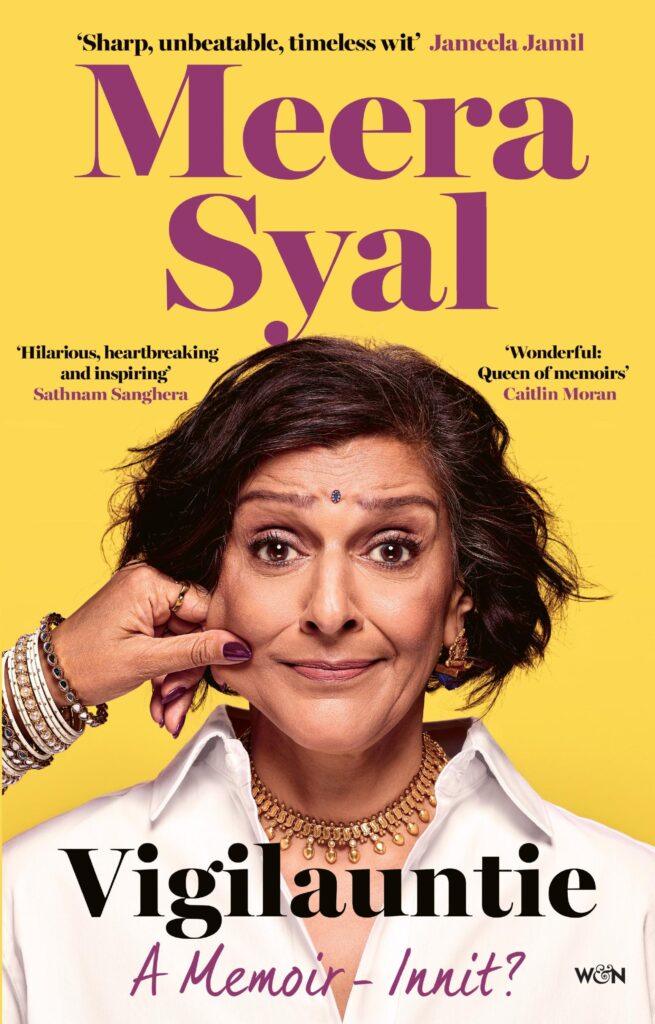
I’d been listening to Vigilauntie on Audible, partly because my actual copy had wandered off somewhere in the house. I wasn’t prepared for how much of my own childhood was in it. Jackie magazine. Worrying about how I looked. The horror of not being asked to dance. I kept stopping and thinking, “Oh my God, that was me.”
Every chapter title in the book is something an auntie once said to her, and if you grew up British Asian, you’ll know those women were never short of an opinion. Meera felt they were policing her. “I was the wrong kind of Indian girl,” she told me. “I didn’t have long straight hair, I wasn’t well-behaved, I didn’t love maths, I didn’t know all the words to prayers.” She was, in her words, “a feral rebel” who loved English at a time when anything creative was seen as a hobby.
Her parents, thankfully, saw her talent and let her explore it. “Many people are alive today because I didn’t become a doctor,” she said, and I laughed out loud.
What I loved is how her view of those aunties has changed. A few were examples of the women she could become. Many more were the women she didn’t want to be: the ones who never got the chances she did. “There’s nothing as sad as unfulfilled potential,” she said. That line has stayed with me.
Of course, I had to ask what the aunties would be asking ChatGPT back in Essington. She didn’t miss a beat: “Find my daughter a husband.” And whose DMs would Granny Ummi be sliding into? “Himesh Patel, Riz Ahmed, the usual.” Then she added Mindy Kaling and Shonda Rhimes, “a real heroine”. Even Ummi has ambitions.
When London was buzzing
I studied media and spent half my youth at Watermans, watching British Asian writers, comedians and musicians burst onto the scene. So I asked her: where has that buzz gone? Or am I just old?
“London felt like the centre of the world, didn’t it?” she said. It was the era of Cool Britannia, and her generation, the first born here, was finding its voice. “The two things colliding made it very buzzy and magical.”
Now, she says, it’s much harder to get anything risky onto terrestrial TV, and “generally brown stories are seen as risky”. Arranged marriage dramas and Raj epics still get made, while shows like Polite Society and We Are Lady Parts have had to fight their way through. The irony is the money. When she wrote Bombay Dreams, she saw what happens when a story speaks to us: “Our community turned up. And they’ve got money.” There’s a huge brown pound out there, and I see it every day across our own communities. We turn up for stories that are ours.
Giants and glass ceilings
What struck me most about Vigilauntie is the struggle behind the success: fourteen months without a contract, sofa surfing, wondering what came next. We see the Dame. We rarely see the graft.
She writes about the impact Shirley Valentine and A Tupperware of Ashes have had on audiences, so I asked how it feels to have become the role model she never had. “You can’t imagine how much that means,” she said. “Because I know how much it would have meant to me to have someone I could go, ‘Well, she’s done it, so maybe I could.'”
Then, straight away, she was talking about everyone else: Nitin Sawhney, Ayub Khan-Din, Tanika Gupta, Anish Kapoor. We talk about standing on the shoulders of giants. Meera is one of those giants, but she always brings the others with her. And she’s clear the work isn’t done. “I’m still knocking on doors,” she said. “It’s very easy from the outside to go, ‘Oh, she’s all right. She’s made it.’ But honestly, we’re all still grafting.”
That graft goes well beyond her own career. She champions so many causes, from the British Asian Trust to dementia, which sits at the heart of A Tupperware of Ashes and of her dad’s story in the book. And she doesn’t shout about any of it.
When I was doing my degree, I interviewed Hanif Kureishi, who was unapologetic about how he portrayed us and refused to be anyone’s spokesperson. So I asked Meera whether she feels that pressure. “You get given that, whether you want it or not,” she said. When Bhaji on the Beach came out, she’d tell people: “This is just my version of being an Indian woman. If you’ve got a different one, you do your programme.” She has also turned down roles, including a Raj epic with white actors browned up, even when she badly needed the money. “I can’t in all conscience do this,” she told them.
“We just got hit with a shoe”
As a mum, the part of the book I most wanted to talk about was generational trauma. What has she done to break the cycle?
“Therapy,” she said, without hesitating. When she mentioned it to one of her aunties, the reply was: “We didn’t get therapy. We just got hit with a shoe.” Anyone who grew up with a chappal in the house will know exactly what she means.
But she was serious about the cure. “Our worst enemy is silence,” she said. “Unless we start talking, we’re never going to clear the air, are we?” She thinks we put far too much emphasis on grades. “We don’t really care what a kid’s emotional intelligence is, as long as you get your 3As.” For her, it’s about raising children who can talk about their feelings and boundaries, and who see their parents not as friends, but as people they can come to without being judged. That matters most of all for boys, who are under so much pressure to bottle things up. “How we bring up our boys as South Asian women is really important.” I couldn’t agree more.
With the clock ticking, I asked about gratitude, which runs all through the book. “I literally start the day or end the day with a thank you to the universe,” she said. “I am an old hippie.” She has a meditation room with a little shrine, and gives thanks for her family, a roof over her head and doing the job she loves. “Honestly, it changes the way you live.”
Did she practise it back in those sofa-surfing days? “I wish I had,” she admitted. It’s something she’s learned with age and now passes on to her children. “Instead of going, ‘Why me?’ It’s like, ‘Why not me?’ Everyone has bad bits in their life, but they’re not forever.”
Part two, over chai
When someone behind the camera called out “Three!”, I still had a page of questions left. I never did get to ask how she and Sanjeev got together. When I heard that part of the book, my mind went straight to Monica and Chandler.
But I came away with something better than an answer. I’d expected the characters. Instead, I met the woman who created them: thoughtful, generous and still knocking on doors so the rest of us can follow. The girl who was told she was the wrong kind of Indian girl turned out to be exactly the kind we needed.
So, Dame Meera, if you’re reading this, I think we need a part two. Over chai this time. When I asked if that was chai in your cup, you did say, “I wish.”
Vigilauntie: A Memoir – Innit? by Meera Syal is out now (W&N).